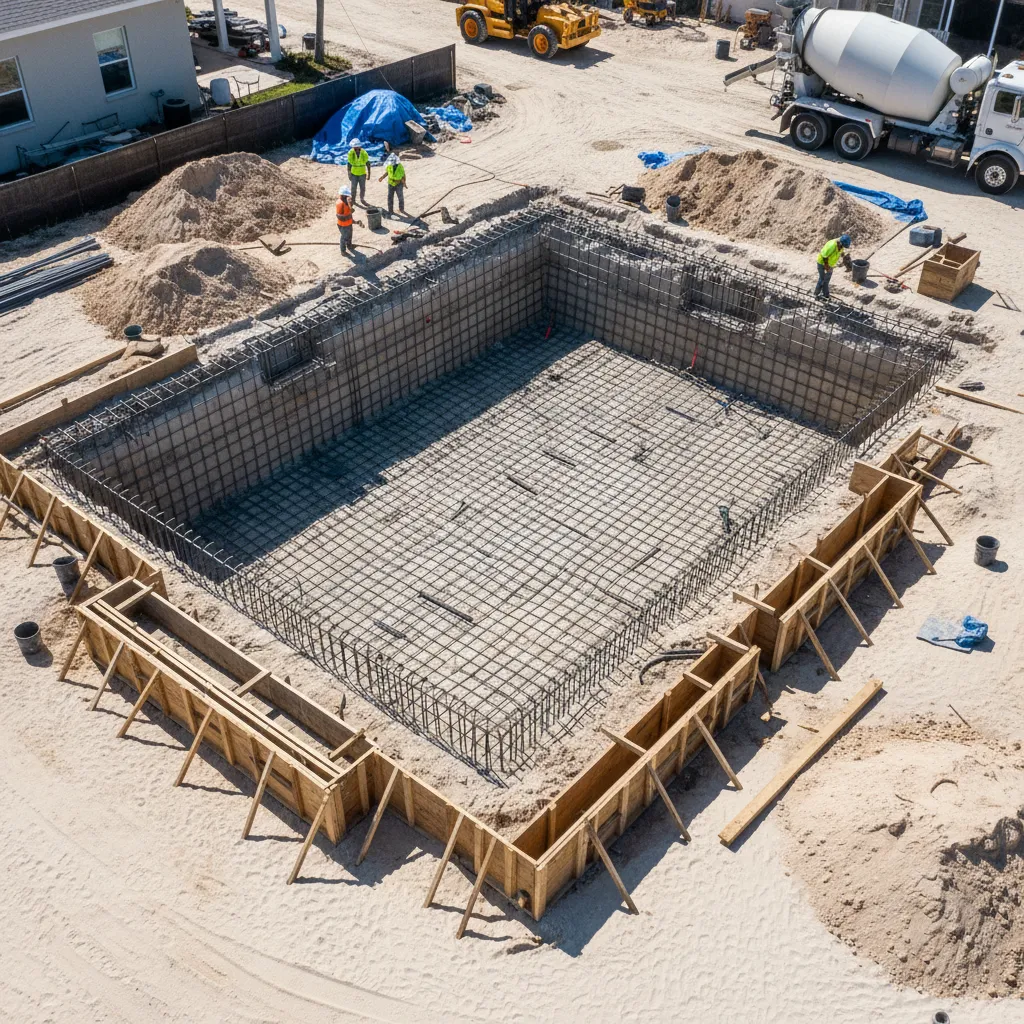
WFP stopped the bleeding on our project timelines. We finally have a single source of truth for every phase.
The Complexity of Pool Construction, Solved.
We did not learn about these problems from a focus group. We lived them while managing 60+ simultaneous pool builds across Florida municipalities.
01
Permits Expiring Across Multiple Municipalities
You pull permits in Hillsborough, Pasco, Pinellas, and Manatee. Each has different expiration timelines. A permit expired in Pasco 10 days ago and your PM did not notice because she was tracking them on sticky notes. The inspector showed up and shut the project down.
Inspector arrives, work stops, re-permitting begins.
02
Subcontractors With Lapsed Insurance on Your Job Sites
Your plumber's workers' comp expired three weeks ago. You assigned him to a job because nobody checked. One injury with an uninsured sub on your site exposes you to $10,000 to $500,000+ in liability. The compliance dashboard would have flagged it before the assignment.
Draws Sitting Uncollected While You Fund Someone Else's Pool
You have $400,000 in uncollected draws across 30 builds, but you could not tell someone the exact number without spending an hour in spreadsheets. Every week that draw sits uncollected is a week you are bankrolling the customer's project out of your own cash flow.
Customers Calling for Updates on 8-to-12-Week Builds
A homeowner calls asking when the gunite crew is coming. Whoever answers has to track down a PM who looks up the project and calls back. Multiply that by 40 builds. Meanwhile, the customer who did not call just left a 2-star review about communication.
Communication complaints across 40 simultaneous builds.
05
Inspection Failures That Stall Projects for Weeks
An inspection failed on Monday. Your PM did not log it. The project sat idle for two weeks before anyone realized the sub needed to come back for remediation. The homeowner is asking why their pool is three weeks behind schedule.
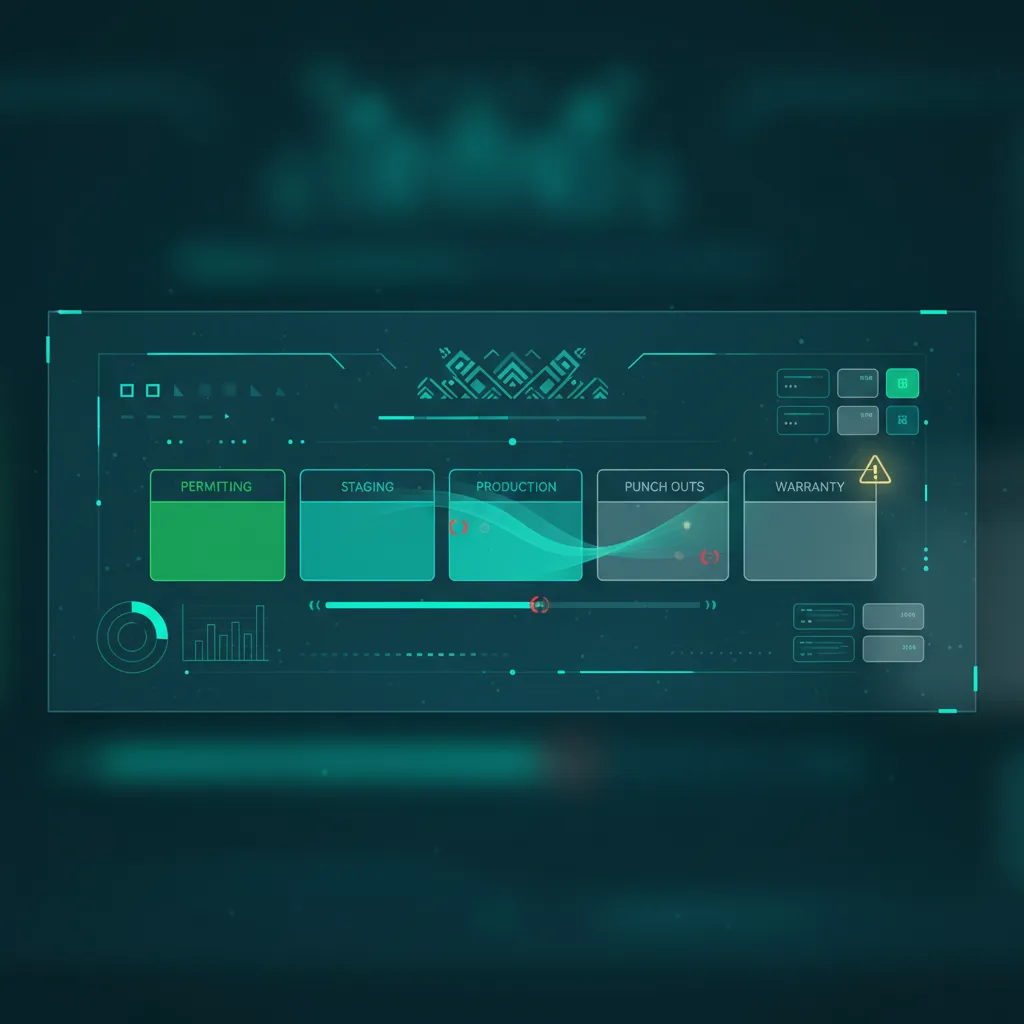
Projects advance automatically through Permitting, Staging, Production, Punch Outs, and Warranty based on completion triggers. "In Phase" duration tracking flags any build stuck too long in staging or permitting. Configurable per project type.
Green: compliant. Yellow: expiring within 30 days. Red: expired. Non-compliant subs cannot be assigned to work orders. You will never accidentally send an uninsured sub to a job site again.
See every dollar coming in, going out, and sitting uncollected across every active pool build. The gamified collections dashboard turns weekly collection targets into team accountability. PMs commit to targets; collected vs. collectible updates in real time.
Configurable SMS updates so homeowners know what is happening without calling the office. Any team member can answer a customer call instantly because the information is in the system, not in one PM's head.
WFP prevents you from completing a project step if required inspections have not passed. Permit countdowns, inspection status (passed, pending, failed), and dedicated permitting phases ensure nothing slips.
These are not five separate tools bolted together. A work order completion triggers a phase advancement. A phase advancement triggers a draw notification. A draw collection updates the financial dashboard. Everything connects, because that is how pool construction actually works.
Build Phase Lifecycle
1
Permitting
2
Staging
3
Production
4
Punch Outs
5
Warranty
Each phase has configurable steps, required inspections, and automated triggers. No phase can be skipped if prerequisites are unmet.
Battle-Tested in Pool Construction
Built before it was sold.
A software engineer acquired a pool construction company and discovered what every pool builder already knows: nothing on the market handled the real complexity. Permits across Florida counties, inspections gating every phase, subs with lapsed workers' comp, draws tied to gunite and plaster milestones, and 20 builds growing to 60+, all running simultaneously.
So he built WFP from scratch and ran the entire operation through it. The numbers on the right are not benchmarks or pilot data. They are what the company hit while running on the platform you are evaluating.
Run inside the company before any outside customer
Run as the operating system of a real pool company before it was offered to anyone else.
Not another generic PM tool. Not a lightweight pool CRM.
WFP occupies a category of one: pool-construction-proven depth with construction-operating-system breadth, at a flat $2,500/month with unlimited users and unlimited projects. No per-seat anxiety as your team grows. No feature gating. No 6-month onboarding marathon.
Capability comparison across Buildertrend, JobTread, Poologics/ProDBX, and WFP.
Sub compliance health dashboardBlocks non-compliant assignment automatically
Yes
Draw management tied to pool milestonesGunite, plaster, deck pour triggers
Yes
Inspection enforcementCannot advance phase if inspection unpassed
Pricing modelFlat $2,500, unlimited
Onboarding time4 weeks, hands-on
Yes
Built inside a pool company
vs. Buildertrend
No
Pool-specific phase automation
No
Sub compliance health dashboard
No
Draw management tied to pool milestones
Partial
Inspection enforcement
Pricing modelPer-user, opaque
Onboarding time6–12 months
No
Built inside a pool company
vs. JobTread
No
Pool-specific phase automation
No
Sub compliance health dashboard
No
Draw management tied to pool milestones
Partial
Inspection enforcement
Pricing model$199 + $20/user
Onboarding timeWeeks–months
No
Built inside a pool company
vs. Poologics / ProDBX
No
Pool-specific phase automation
No
Sub compliance health dashboard
No
Draw management tied to pool milestones
No
Inspection enforcement
Pricing model$49–$329/mo
Onboarding timeDays–weeks
No
Built inside a pool company
Vs. Buildertrend
6-to-12-month implementation timeline and opaque per-user pricing, with no pool-specific anything underneath. If your team spent 6 months trying to adopt it and never got there, the tool failed you, not the other way around.
Aggressively entering pool with PoolCorp integration, but $199 plus $20/user punishes the moment you cross 40 simultaneous builds. The pool depth is not there yet.
One Price. Everything Included. Unlimited Everything.
$2,500/month
Unlimited users. Unlimited projects. All 14 modules. No per-seat pricing. No feature gating.
15 users = $167/user · 30 users = $83/user
01
$10K-$500K+
One uninsured sub incident
Your plumber's workers' comp expired. One injury on your job site. WFP's sub compliance dashboard prevents non-compliant subs from being assigned to any work order before it can happen.
02
$90K-$240K+
Three lost referrals from poor communication
Three customers who didn't get updates during their 10-week pool builds. Three 2-star reviews. Three referrals that went to your competitor. WFP's customer portal and automated SMS updates prevent this.
03
$15K-$30K
One PM quitting due to broken tools
Recruiting, onboarding, and lost productivity when a PM leaves because the tools fight them. WFP gives PMs visibility, accountability, and organization, reasons to stay.
The question is not whether $2,500/month is expensive. The question is whether you can afford the cost of chaos for another month.
Pool builders use Buildertrend and Procore for general construction management, Poologics and ProDBX for pool-specific CRM and scheduling, and JobTread for project tracking. WFP occupies a different category, a construction operating system built inside a real pool construction company. It handles sub compliance dashboards, phase-based automation tied to pool construction milestones (Permitting, Staging, Production, Punch Outs, Warranty), gamified draw collections, commission transparency portals, and PM route mapping. No other tool in the pool builder space offers all five in one integrated platform.
Pool construction software ranges from $49-$329/month for basic CRMs (Poologics) to $199/month plus $20/user for mid-market tools (JobTread) to $4,500-$25,000+/year for enterprise platforms (Procore). WFP is $2,500/month with unlimited users and unlimited projects. At 15 users, that's $167/user/month. At 30 users, $83/user/month. The per-user cost decreases as your team grows, the opposite of per-seat tools that punish growth.
Yes, Poologics, ProDBX, and JobTread all include CRM functionality for pool builders. But a CRM alone doesn't solve the operational complexity of running 20+ simultaneous pool builds. WFP includes CRM alongside project management, sub compliance tracking, financial management with draw collections, inspection and permit automation, work orders, customer communication portals, scheduling and route mapping, commission tracking, and 6 additional modules. It's the difference between a tool and an operating system.
Typical implementation is 4 weeks with hands-on support. We handle the data migration from your current system so your team doesn't lose a production day. Robert, a project manager at a WFP client, described it as 'very intuitive to just jump into it and figure things out fairly quickly just by poking around.' Compare that to Buildertrend's 6-to-12-month implementation timeline. WFP is designed for construction teams, not IT departments.
Yes. WFP supports configurable project types: pools, outdoor kitchens, spas, renovations, additions, and any construction vertical. Each project type has its own phases, steps, and file requirements. You can run pool builds and outdoor kitchen projects from the same dashboard without any workflow conflicts.
This is the most important question. Failed Buildertrend adoptions have made many pool builders skeptical of new software, rightfully so. WFP's design philosophy prioritizes intuitive operation over feature bloat. Subcontractors access their tasks through a free mobile-optimized portal with no per-seat license. PMs can navigate the system on day one. And because unlimited users are included at the flat rate, there's no incentive to limit access or work around the system. Everyone is in the loop from day one.
Ready to Transform Your Pool Construction Operation?
30 minutes. Your projects. Your pain points. We will show you how WFP handles them, with pool construction terminology, not generic construction theory.